The Backyard Field Notebook
Look at the wings. Check the mouthparts. Then follow the clues.
The small visitor on your window might be a beetle, a true bug, or a fly. Learning a few visible features can turn a vague guess into a useful identification—without memorizing hundreds of species.
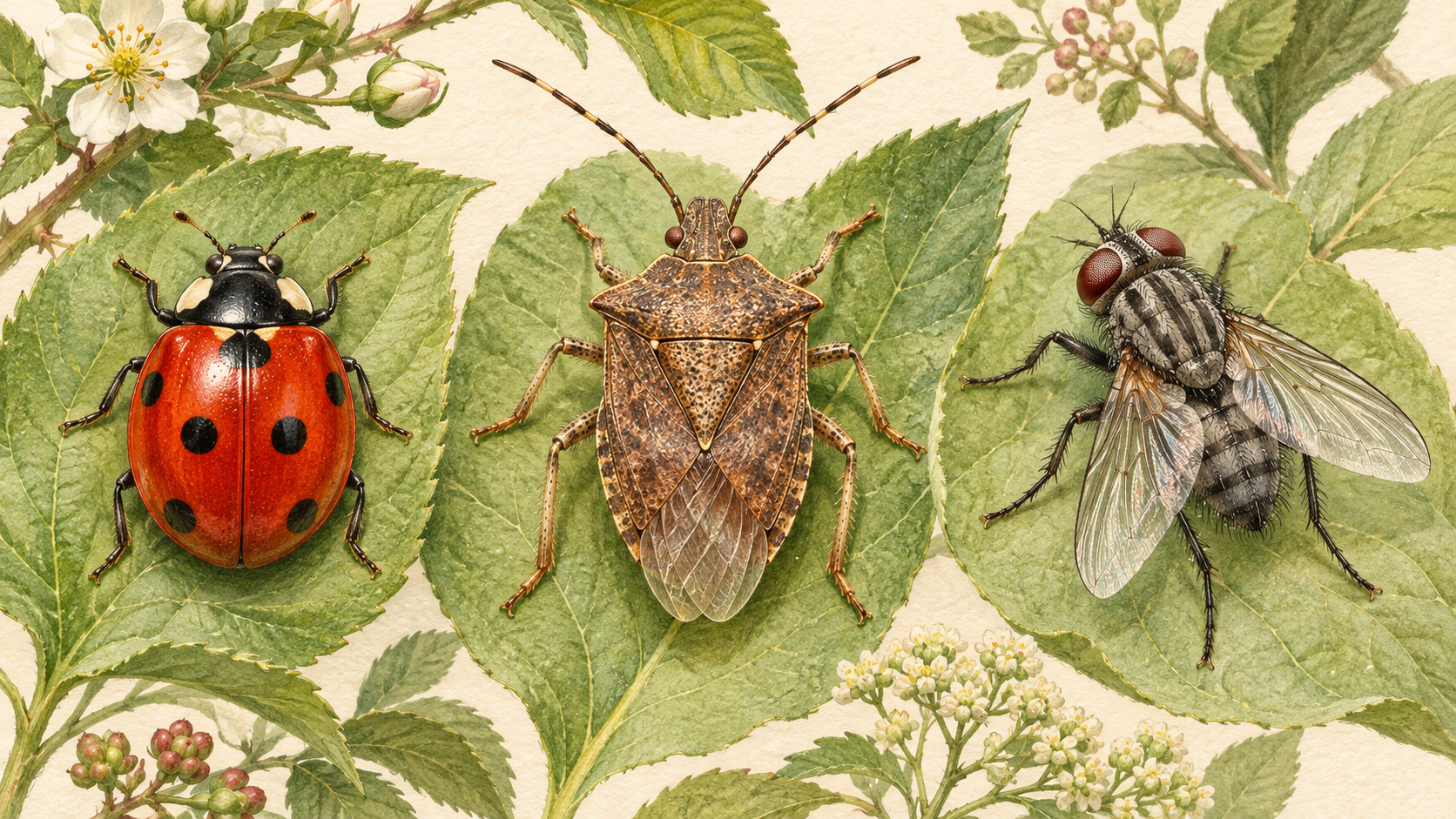
A ladybug rests on a leaf. A shield-shaped insect walks across a fence. A yellow-and-black visitor hovers above a flower. All three are insects, but they belong to different groups with different body structures, feeding methods, and life cycles.
Everyday names make identification confusing. People often call almost any small crawling animal a “bug,” while insects that resemble bees may actually be flies. Even familiar names can hide useful clues: a ladybug is a beetle, and a firefly is also a beetle.
The easiest way to begin is to identify the broad group before trying to name the species. Wings, mouthparts, antennae, and body shape provide a practical starting point. These features are especially helpful when observing common adult insects in gardens, parks, and around homes.
First, make sure you are looking at an insect
Adult insects have six legs, one pair of antennae, and three main body regions: the head, thorax, and abdomen. The legs attach to the thorax, which also carries the wings when wings are present.
Spiders have eight legs and no antennae. Centipedes and millipedes have many body segments with numerous legs. These animals may share the same garden spaces, but they are not insects.
Count carefully. An antenna can look like a leg in a photograph, and an insect may be missing a limb. Wings or body coverings can also hide the boundaries between body regions. Use several features together rather than relying on one quick impression.
Adult or youngster? The wing clues in this guide mainly apply to adults. Beetle grubs, fly larvae, and young true bugs can look very different from their adult forms.
Beetles: look for the protective wing covers
Beetles belong to the order Coleoptera. Their most recognizable feature is a pair of hardened forewings called elytra. These covers usually meet along a straight seam down the middle of the back.
In many beetles, the delicate hindwings used for flight fold beneath the elytra. When the beetle takes off, the covers lift or move aside so the flight wings can unfold. Some beetles have reduced flight wings and cannot fly.
A ladybug, also called a ladybird, makes this structure easy to recognize. Its rounded, spotted back consists of two wing covers. Ground beetles often show the same central seam on a longer, darker body. Weevils have wing covers too, along with a distinctive snout in many species.
Beetle clues to look for
- Two firm forewing covers, often meeting in a straight central line.
- Chewing mouthparts, although they may be difficult to see.
- Bodies that may be rounded, elongated, flattened, or heavily armored.
- Antennae that vary widely, including clubbed, threadlike, and elbowed forms.
There are exceptions to the familiar armored appearance. Rove beetles have short wing covers that leave much of the abdomen exposed. Some beetles have relatively soft bodies. A straight seam is therefore a helpful clue, but its absence from a poor photograph does not rule out a beetle.
Beetles undergo complete metamorphosis: egg, larva, pupa, and adult. Their larvae include familiar grubs, wireworms, and mealworms. Some beetles eat plants, others hunt small animals, and many help break down dead material.
True bugs: the feeding beak is the strongest clue
In everyday speech, “bug” is a loose label. In insect classification, the name is associated with Hemiptera, a group that includes stink bugs, aphids, cicadas, leafhoppers, and others. Some identification guides use “true bugs” more narrowly for Heteroptera, the subgroup containing stink bugs, assassin bugs, and many aquatic bugs.
The feature that connects hemipterans is their specialized piercing-and-sucking mouthparts. These form a beak, or rostrum, used to take liquid food. Depending on the insect, that food may be plant sap or fluids from animal prey. Some species feed on blood, but that behavior does not describe the whole group.
On a stink bug or assassin bug, the beak is usually folded beneath the head and body when not feeding. A clear side or underside view may reveal it more easily than a photograph from above.
Many adult heteropterans have forewings that are firmer near the base and membranous toward the tips. These are called hemelytra. When folded, they often produce an overlapping, roughly X-shaped pattern across the back. A triangular plate called the scutellum may also be visible between the wing bases.
Do not apply the X-pattern rule to every hemipteran.
Cicadas have transparent wings, leafhoppers hold their wings rooflike, and many aphids are wingless. The piercing-and-sucking mouthparts are a more reliable group feature than one particular back pattern.
Hemipterans develop through incomplete metamorphosis: egg, nymph, and adult. Their nymphs generally resemble smaller, wingless versions of the adults, although colors and proportions can differ. Wing pads become more noticeable as winged species approach adulthood.
Flies: one flight-wing pair and a hidden balancing system
True flies belong to the order Diptera. Most winged adults have one pair of functional flight wings. Their hindwings are modified into small balancing organs called halteres, which help them sense body rotation during flight.
This separates flies from beetles and many other winged insects, which typically have two wing pairs, even when one pair is modified or difficult to see. On a fly, the halteres sit behind the main wings and may look like tiny stalks with rounded ends.
House flies, hoverflies, mosquitoes, crane flies, and midges all belong to Diptera. That variety explains why body shape alone is unreliable. A mosquito looks very different from a house fly, yet both share the same basic wing arrangement.
Many familiar flies have large eyes and short antennae, but mosquitoes and crane flies show why those features are only supporting clues. Fly mouthparts vary too: some sponge up liquids, some pierce, and others are adapted for taking nectar.
The bee look-alike at the flower
Many hoverflies have yellow-and-black markings that resemble bees or wasps. Check the wings before judging the stripes. A fly has one functional wing pair; bees and wasps have two pairs, although their smaller hindwings can be difficult to distinguish.
Flies undergo complete metamorphosis. Their larvae include maggots and the aquatic “wrigglers” of mosquitoes. Many fly larvae lack obvious jointed legs, but they vary considerably in appearance. Adult flies can pollinate flowers, and their larvae may recycle organic material, hunt other insects, or feed on living plants and animals.
Compare the three groups at a glance
| Feature | Beetles | True bugs / Hemiptera | Flies |
|---|---|---|---|
| Best starting clue | Hardened forewing covers | Piercing-and-sucking beak | One functional wing pair |
| Wing appearance | Often a straight central seam | Variable; many heteropterans show overlapping tips | Usually membranous, with halteres behind |
| Development | Larva and pupa | Nymph; no pupal stage | Larva and pupa |
| Familiar examples | Ladybugs, weevils, ground beetles | Stink bugs, aphids, cicadas | House flies, hoverflies, mosquitoes |
A practical way to examine an unfamiliar insect
Start with the insect at rest. Look from above for wing covers, a central seam, or overlapping wing tips. Then try a side view to examine the head, antennae, and any visible beak.
If it flies naturally, watch the takeoff. A beetle may reveal hidden hindwings beneath its covers. A resting fly may hold its two wings together or overlap them, so a single view can make wing counting difficult.
Record the setting as well. An insect on a pond surface, beneath loose bark, or beside a cluster of aphids comes with useful ecological context. Location, season, approximate size, and behavior can help narrow the possibilities after the broad group is identified.
For photographs, take a sharp top view and a side view if possible. Move slowly, use available light, and avoid blocking the insect with your shadow. Photograph a nearby ruler or another safe size reference when practical; do not handle an unfamiliar insect just to improve the picture.
Common shortcuts that lead to wrong answers
Color is not a dependable first test. Unrelated insects can share nearly identical markings. Members of one species may also differ in color because of age, sex, or natural variation.
A hard-looking body does not automatically mean beetle. Stink bugs can appear armored too. Check whether the back has separate wing covers and examine other features.
Not every flying insect is a fly. Bees, wasps, moths, beetles, and many true bugs can fly. “Fly” in classification refers specifically to Diptera.
Being on a damaged plant does not prove responsibility. A beetle may be hunting pests, a bug may be feeding on another insect, and a fly may simply be resting. Observe feeding or look for more evidence before deciding what caused the damage.
A missing feature may simply be hidden. Folded wings, tucked mouthparts, and awkward camera angles often conceal the most useful clues. An uncertain identification is better than forcing a confident answer from incomplete evidence.
Let the body structure guide your answer
For an adult insect, begin with three questions: Does it have hardened wing covers? Does it have a piercing-and-sucking beak? Does it have one functional pair of wings with halteres behind?
Those questions will not identify every species, but they provide a strong foundation for separating beetles, true bugs, and flies. With practice, a quick glance becomes a closer observation—and an ordinary garden becomes much more interesting.