SMALL CREATURES, REMARKABLE TRANSFORMATIONS
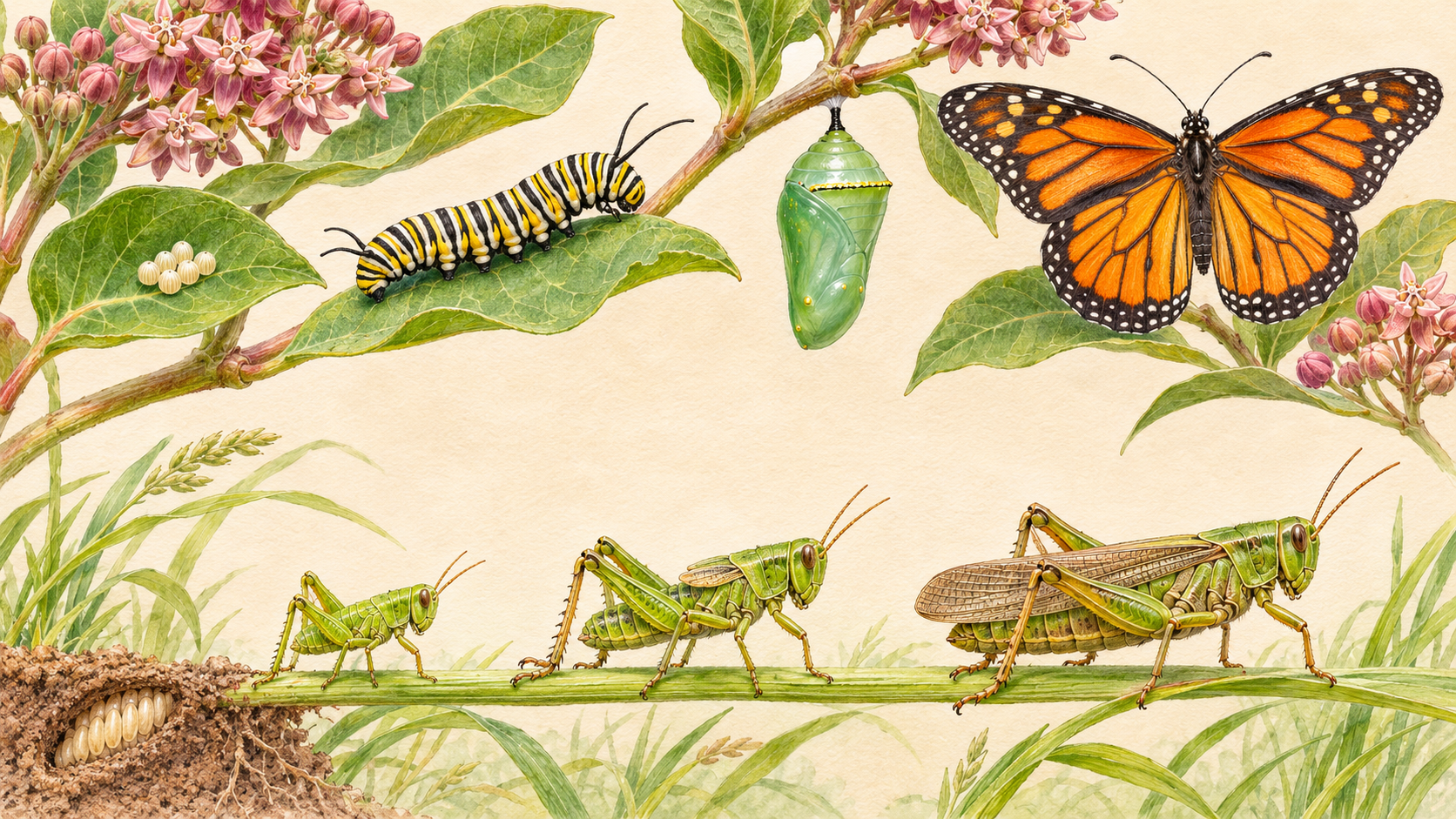
A caterpillar becomes a butterfly, but a young grasshopper grows into a larger, winged version of a familiar shape. Both insects transform as they develop. They simply follow different routes to adulthood.
A garden, neighborhood pond, or patch of meadow contains insects at many stages of life. Some young insects look so different from their parents that they seem unrelated. Others are recognizable almost immediately, although they lack the wings and reproductive maturity of adults.
These differences reflect two major patterns of insect development: complete metamorphosis and incomplete metamorphosis. Understanding them helps explain more than changing appearances. It reveals why insects occupy different habitats, eat different foods, and become noticeable at particular times of year.
The distinction is straightforward once you know what to look for. Complete metamorphosis includes a pupal stage between the growing juvenile and the adult. Incomplete metamorphosis does not. Behind that simple difference are two fascinating ways to build an adult insect.
First, why insects cannot simply keep stretching
Insects have an external covering called an exoskeleton. It supports the body, provides protection, and helps limit water loss. However, its relatively rigid outer layers cannot expand continuously as the insect grows.
Instead, an insect periodically sheds its old outer covering through a process called molting. Before a molt, a new covering forms beneath the old one. After shedding, the insect expands while the new covering is still soft, then the covering hardens.
Each developmental stage between molts is called an instar. An insect may pass through several juvenile instars before becoming an adult. The number varies among species and can sometimes be influenced by growing conditions.
Molting and metamorphosis are connected, but different. Molting is the shedding of an outer covering. Metamorphosis is the developmental change in body form and function that occurs as an insect progresses toward adulthood.
Two routes through an insect’s life
| Feature | Complete metamorphosis | Incomplete metamorphosis |
|---|---|---|
| Main stages | Egg, larva, pupa, adult | Egg, nymph, adult |
| Young insect | Usually very different from the adult | Often resembles the adult, but differences can be substantial |
| Pupal stage | Present | Absent |
| Examples | Butterflies, beetles, flies, bees | Grasshoppers, true bugs, dragonflies, cockroaches |
Complete metamorphosis: a life with distinct chapters
Complete metamorphosis separates juvenile growth from the adult body form. A caterpillar does not gradually develop visible butterfly wings while crawling from leaf to leaf. It feeds and grows as a larva, then undergoes extensive reorganization during the pupal stage.
The egg: development begins
The embryo develops inside an egg. Many female insects place their eggs where newly hatched larvae can reach suitable food. A butterfly may lay eggs on a particular host plant, while some beetles lay them in soil, wood, or stored food.
Egg placement matters because young larvae may have limited ability to travel. The right location can provide food, shelter, and an appropriate level of moisture during a vulnerable part of life.
The larva: feeding and growing
A larva is the immature feeding stage. Caterpillars, maggots, and many grubs are familiar examples, although larvae come in a wide variety of forms. Some chew plants, some hunt other animals, and others consume decaying organic material.
Larvae generally molt several times as they grow. Their basic body form remains recognizable through these instars, even when their color, markings, or proportions change. They accumulate resources that support later development.
The pupa: extensive internal change
After its final larval stage, the insect becomes a pupa. It usually stops feeding, and major changes produce the adult body. Some larval tissues break down, while other tissues persist, reorganize, or develop into adult structures.
The process is more precise than the popular image of an insect completely dissolving into shapeless liquid. Developing structures and coordinated biological signals guide the formation of adult features, including wings, legs, sensory organs, and reproductive systems.
Chrysalis or cocoon? A chrysalis is a butterfly’s pupa. A cocoon is a protective covering, often made of silk, around the pupa of certain insects, including many moths. The covering and the developmental stage are different things.
The adult: a different set of priorities
The adult emerges with its mature body form. In winged species, the wings expand and harden before normal flight becomes possible. Reproduction becomes a central role, and flight may help adults disperse and find mates or egg-laying sites.
Adult feeding habits vary. Many butterflies drink nectar, while adult mosquitoes have feeding behaviors that differ by sex and species. Some adult insects feed little or not at all, relying heavily on resources accumulated earlier.
Incomplete metamorphosis: change across successive molts
Incomplete metamorphosis follows an egg–nymph–adult pattern. There is no pupal stage. Instead, the juvenile develops toward adulthood through a series of molts, with the final molt producing the adult form.
A young grasshopper illustrates this pattern well. It has the same general body arrangement as an adult and moves through a similar environment. However, it is smaller, reproductively immature, and lacks fully developed adult wings.
In many winged species, external wing pads become more noticeable during later nymphal stages. Adult wings become functional after the final molt. Some species have reduced wings or remain wingless, so wings alone cannot identify every insect’s life stage.
Not every nymph looks like a miniature adult
Dragonflies demonstrate why this description needs care. Their nymphs live underwater, breathe using specialized structures, and capture aquatic prey. Adults fly through the air and hunt insects above ponds, fields, and gardens.
A mature dragonfly nymph climbs out of the water before its final molt. The adult emerges from the old covering, expands its wings, and eventually flies away. The transformation is dramatic, yet it remains incomplete metamorphosis because no pupal stage occurs.
Aquatic juveniles of insects such as dragonflies and mayflies are also sometimes called naiads. Their different habitat and appearance show that incomplete metamorphosis does not mean development is simple or visually unremarkable.
Why different life stages often eat different foods
Complete metamorphosis allows larvae and adults to specialize in different activities and resources. A caterpillar’s chewing mouthparts suit eating plant material, while many adult butterflies use a long proboscis to drink liquids.
This separation can reduce competition between juveniles and adults of the same species. It also allows the larval body to specialize in feeding and growth while the adult body supports dispersal and reproduction. However, different diets are common rather than universal; some larvae and adults use similar resources.
In incomplete metamorphosis, young and adult insects often share food and habitat, as grasshoppers do. Aquatic insects provide an important exception. A dragonfly’s underwater youth and flying adulthood occupy very different ecological settings.
What controls the timing of these changes?
Hormones coordinate molting and development. Ecdysteroids help initiate the molting process, while juvenile hormone helps determine the kind of developmental transition that occurs. Its effects depend on the insect’s stage and biological context.
Environmental conditions also influence timing. Temperature, food availability, and seasonal signals can affect development. Within suitable limits, warmer conditions often speed growth, but excessive heat can cause stress or death.
Some insects enter diapause, a regulated pause in development that helps them survive unfavorable seasons. Depending on the species, winter may be spent as an egg, larva, pupa, nymph, or adult. There is no single overwintering stage shared by all insects.
Look for the life stage, not just the insect
On your next outdoor walk, examine leaves for eggs, watch for feeding larvae, and look for empty insect coverings on stems near water. Photographing what you find can reveal changes that are easy to miss in a single visit.
Observe without opening cocoons, pulling insects from their coverings, or moving aquatic nymphs onto dry ground. These stages can be delicate, especially during emergence and immediately after molting.
“Incomplete” does not mean unfinished
Both developmental patterns produce fully mature insects. The word “incomplete” describes the absence of a distinct pupal stage, not a failure to complete development. A grasshopper is no less fully developed than a butterfly.
The most reliable distinction is the sequence: complete metamorphosis has egg, larva, pupa, and adult stages; incomplete metamorphosis has egg, nymph, and adult stages. Appearance offers useful clues, but the presence or absence of a pupa defines the difference.
Once those patterns become familiar, ordinary outdoor spaces reveal a richer story. A caterpillar on a leaf, a grasshopper nymph in the lawn, and a dragonfly’s empty covering beside a pond are evidence of different journeys toward adulthood—each closely connected to the food, habitat, and seasons around it.