Complete vs Incomplete Metamorphosis How Insects Grow and Change

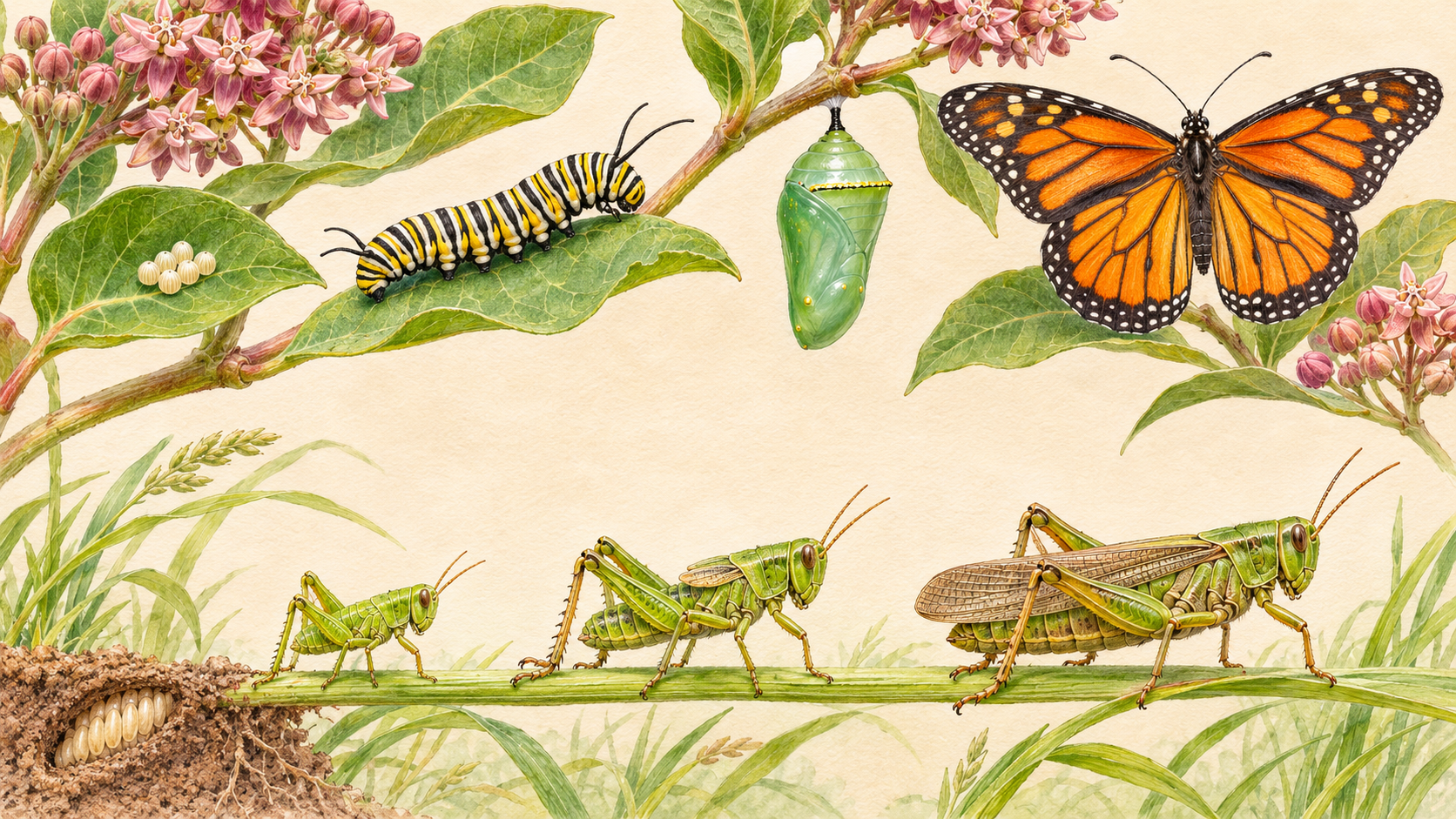
SMALL CREATURES, REMARKABLE TRANSFORMATIONS A caterpillar becomes a butterfly, but a young grasshopper grows into a larger, winged version of a familiar shape. Both insects transform as they develop. They simply follow different routes to adulthood. A garden, neighborhood pond, or patch of meadow contains insects at many stages of life. Some young insects look … Read more

Cicada Broods and Underground Emergence: The Mathematics of 13-Year and 17-Year Prime Cycles

Every spring in eastern and midwestern North America, annual “dog-day” cicadas emerge in late summer to serenade the canopy. But at vast, predictable intervals, an entirely different biological spectacle occurs: the explosive emergence of Magicicada—the periodical cicadas. Synchronously tunneling out of the subterranean darkness after precisely 13 or 17 years underground, tens of billions of … Read more

From Egg to Imago: The Complete Metamorphosis of Monarch and Swallowtail Butterflies

The life journey of a butterfly from a microscopic, jewel-like egg to a dazzling, winged aerial navigator is one of nature’s most celebrated miracles. In North America, few species capture public admiration more profoundly than the Monarch (Danaus plexippus) and the Eastern Tiger Swallowtail (Papilio glaucus). Yet beneath the poetic beauty of a caterpillar transforming … Read more

The Science of Insect Diapause: How Invertebrates Survive Freezing North American Winters

As autumn descends across the northern latitudes of North America, temperatures plummet far below the freezing point of water. For ectothermic organisms whose core body temperatures mirror ambient weather, sub-zero winter extremes pose a mortal thermodynamic hazard: the expansion of intracellular ice crystals that slice through phospholipid cell membranes and shred internal organelles. Yet, each … Read more

Holometabolous vs. Hemimetabolous: Complete vs. Incomplete Metamorphosis Explained

Metamorphosis represents one of the most radical biological transformations in the animal kingdom. Rather than growing continuously through simple cellular expansion, an insect must periodically shed its rigid chitinous exoskeleton to increase in size, often transforming fundamentally in form, physiology, and ecological function between juvenile and adult stages. In evolutionary entomology, this transformative journey is … Read more