Complete vs Incomplete Metamorphosis How Insects Grow and Change

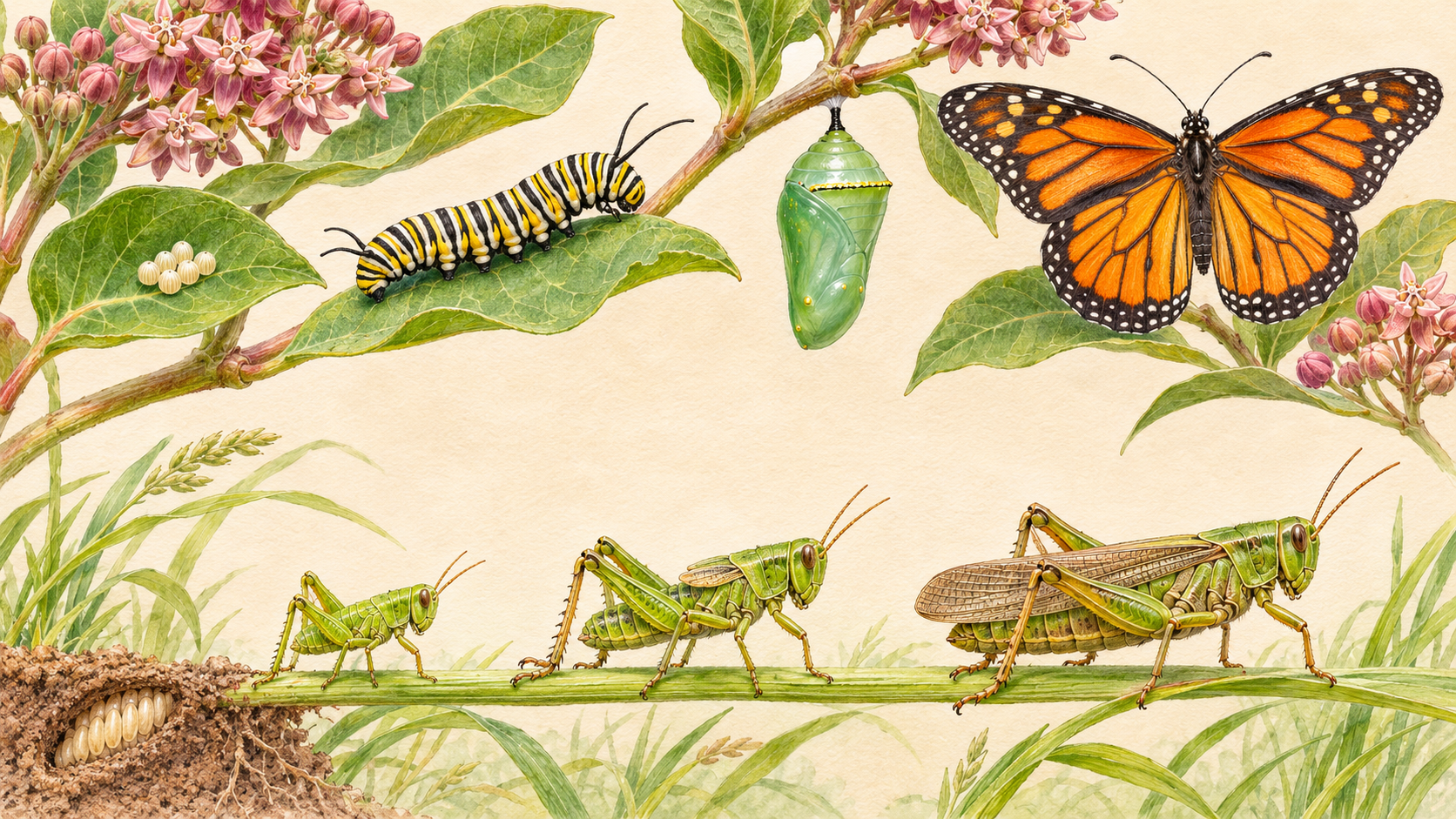
SMALL CREATURES, REMARKABLE TRANSFORMATIONS A caterpillar becomes a butterfly, but a young grasshopper grows into a larger, winged version of a familiar shape. Both insects transform as they develop. They simply follow different routes to adulthood. A garden, neighborhood pond, or patch of meadow contains insects at many stages of life. Some young insects look … Read more

Insect Defense and Mimicry: Batesian vs. Müllerian Strategies, Startle Displays, and Chemical Sprays

In the high-stakes theater of natural selection, insects occupy a perilous ecological position: they are the primary protein source for millions of birds, reptiles, amphibians, and small mammals. Because physical speed alone is often insufficient to evade sharp-eyed predators, insects have evolved the most dazzling, deceptive, and devastating defensive repertoires in the animal kingdom. From … Read more

Bioluminescence and Visual Signaling: The Synchronous Firefly Displays of the Great Smoky Mountains

Every year in early June, deep within the ancient hardwood forests of the Great Smoky Mountains National Park, thousands of spectators gather in complete silence to witness one of North America’s most awe-inspiring natural phenomena: the synchronous light display of the firefly Photinus carolinus. Unlike ordinary fireflies whose flashes twinkle erratically across summer meadows, millions … Read more

Eusociality and Superorganisms: Caste Systems, Division of Labor, and Architecture in Ant and Termite Colonies

In the study of evolutionary biology, few phenomena are more profound than eusociality—the evolutionary transition from solitary individualism to cooperative colonial living. Coined by entomologist E.O. Wilson, the concept of the “superorganism” views an ant colony, termite mound, or honeybee hive not merely as a collection of individual animals, but as a single, coherent biological … Read more

The Chemical Language of Insects: Pheromones, Alarm Signals, and Trail-Following Dynamics

While humans perceive the world predominantly through vision and acoustic speech, the vast majority of the Earth’s one million insect species communicate through an invisible, silent sensory channel: chemical language. Through the synthesis and detection of semiochemicals—volatile organic molecules secreted into air currents or deposited onto substrates—insects coordinate monumental colonial tasks, attract mates across miles … Read more

Urban and Suburban Insect Ecosystems: Biodiversity in American Backyards, Green Roofs, and Parks

As urban sprawl transforms millions of acres of wild forest and native prairie into concrete infrastructure, asphalt roadways, and manicured suburban turfgrass, a fundamental ecological question arises: can insect biodiversity survive in modern human cities? Traditional conservation models historically viewed urban centers as ecological wastelands. However, pioneering entomological field research across major American metropolitan areas—from … Read more

Desert Arthropod Adaptations: How Darkling Beetles and Ants Conquer Extreme Heat and Aridity

The arid deserts of the American Southwest—the Sonoran, Mojave, Chihuahuan, and Great Basin deserts—represent some of the most physiologically hostile landscapes on Earth. Surface sand temperatures frequently exceed 140°F (60°C), atmospheric humidity hovers near single digits, and standing liquid water is practically non-existent for months at a time. For small ectothermic animals with exceptionally high … Read more