Small Creatures · Extraordinary Engineering
A spider’s silk can become a trap, a shelter, or a safety line.
That delicate web outside your window is more than a collection of sticky threads. It is a carefully arranged hunting structure. Yet many spiders catch every meal without building a prey-catching web at all.
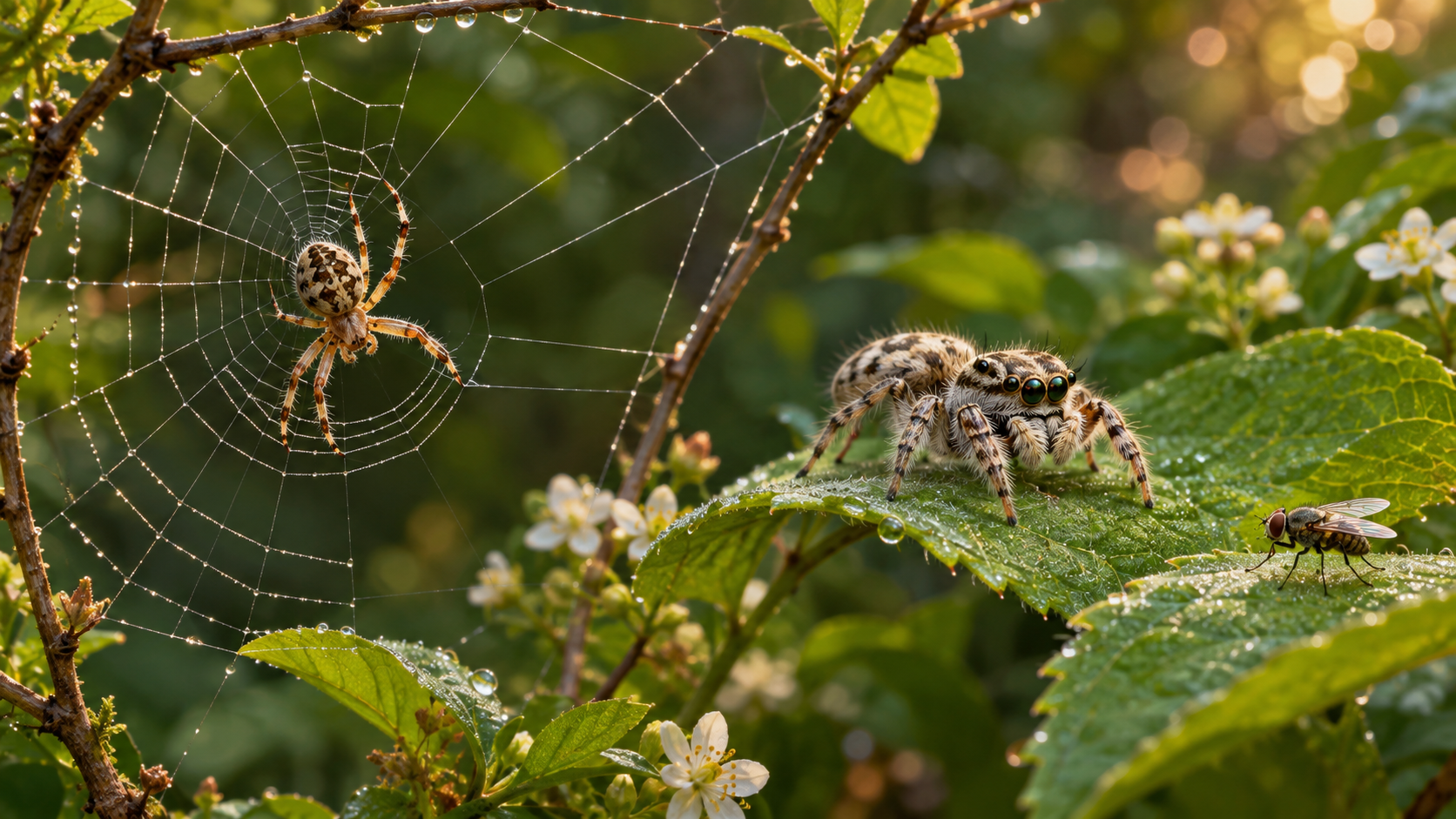
A web covered in morning dew makes a spider’s work easy to appreciate. Fine threads stretch between plants, droplets outline a spiral, and the entire structure seems almost impossibly light. What looks fragile, however, can intercept a flying insect and transmit its movements directly to the waiting spider.
Spiders have evolved many ways to use silk, and web building is only one of them. Some construct familiar wheel-shaped traps. Others weave tangled networks, spread sheets over vegetation, or hide behind silken funnels. Jumping spiders stalk their targets, wolf spiders pursue prey on foot, and crab spiders wait for insects to come within reach.
Understanding these different approaches starts with a useful distinction: all spiders produce silk, but not all spiders use it to build prey-catching webs.
Silk Begins as a Liquid Inside the Spider
Spider silk begins as a concentrated mixture of proteins inside specialized abdominal glands. As this material passes through narrow ducts, changes in its chemical environment and the forces acting on it help organize the proteins into a solid fiber.
The silk exits through tiny openings associated with structures called spinnerets. These movable organs help the spider position its threads. Depending on the species and purpose, the spider may produce silk for structural support, prey wrapping, egg protection, or attachment to a surface.
One Animal, Several Kinds of Thread
A spider does not necessarily use the same silk throughout a web. In a typical orb web, supporting lines must carry tension, while the capture spiral needs to hold struggling prey. These jobs call for different properties.
Dragline silk, used for major supports and safety lines, combines strength with some ability to stretch. The capture spiral of many familiar orb webs uses more extensible silk coated with glue droplets. Together, the thread and its coating help retain insects while the web deforms under their movement.
Not every capture thread relies on liquid glue. Some spiders produce extremely fine, woolly silk that catches against features on an insect’s body. Spider silk is therefore better understood as a family of specialized materials than as one universal “super thread.”
Building an Orb Web: From First Bridge to Final Spiral
The classic circular web provides a clear example of construction in stages. Details differ among species, but many orb weavers follow a broadly similar sequence.
1. Establishing a bridge
The spider often begins by releasing a silk line into moving air. If the thread catches on a suitable surface, it creates a connection across an open space. The spider can cross this initial bridge, strengthen it, and use it to establish further supports.
This explains how a web can span a gap that appears too wide for a small spider to cross directly. Air movement helps deliver the first connection, although web placement still depends on suitable attachment points.
2. Creating the frame and spokes
Next, the spider establishes an outer framework and adds radial threads extending toward a central region. These spokes support the eventual capture area and carry vibrations through the finished web.
The web does not have to form a perfect circle. Nearby branches, walls, leaves, and other surfaces influence its outline. A spider can adjust its construction to fit an uneven opening.
3. Laying a temporary guide
Many orb weavers build a widely spaced, nonsticky spiral that helps stabilize the developing structure and provides a route for movement. It acts as a temporary working scaffold while the spider positions the capture threads.
4. Adding the capture spiral
The spider then lays the closely spaced capture spiral, commonly working inward from the outer part of the web. In many species, it removes the temporary spiral as construction progresses.
The result is a coordinated arrangement of supporting and prey-retaining threads. The spider may wait at the center or retreat nearby, maintaining contact through silk that carries signals from the trap.
A Web Extends the Spider’s Sense of Touch
A web does more than intercept insects. It also supplies information. When something strikes the silk, vibrations travel through the network. Sensory structures on the spider’s legs detect tiny movements and mechanical strain.
The spider can use features of these vibrations to help distinguish struggling prey from background disturbances. Wind, falling debris, potential mates, and predators can all produce movement, so responding appropriately matters.
After detecting prey, a spider may approach, wrap it with silk, bite it, or combine these actions in a species-specific sequence. Some web builders have limited visual detail compared with visually specialized hunters, making information carried through silk especially valuable.
Not Every Web Looks Like a Wheel
The wheel-shaped orb is only one solution to catching prey. Other designs suit different locations, prey movements, and hunting behaviors.
| Web design | How it helps catch prey |
|---|---|
| Orb web | An open, often wheel-shaped capture surface intercepts insects moving through a gap. |
| Sheet web | A silken sheet supports interception and capture; some include threads above that knock insects downward. |
| Tangle web | A three-dimensional network obstructs prey, with specialized adhesive lines in some species. |
| Funnel-shaped retreat with sheet | The spider waits in a sheltered funnel and rushes onto the sheet when prey disturbs it. |
These forms also reveal why location matters. An opening between branches favors a different trap from a sheltered corner or dense grass. Web architecture and habitat work together.
Why Some Spiders Hunt Without Capture Webs
A web requires materials, construction time, and a productive location. It can be damaged by weather, disturbed by larger animals, or left empty if few suitable insects pass through. Active hunting offers access to prey that might never enter a stationary trap.
Different spider lineages have evolved bodies and senses suited to different feeding strategies. Some emphasize detailed vision and controlled jumps. Others rely on running, camouflage, touch, or rapid attacks from cover. There is no single hunting method that works best everywhere.
Jumping spiders: stalk, judge, leap
Jumping spiders use their prominent forward-facing eyes to examine potential prey and judge a route toward it. Many approach carefully before pouncing. They commonly attach a silk safety line before jumping, showing that hunting without a capture web still involves silk.
Wolf spiders: search at ground level
Many wolf spiders hunt across soil, leaf litter, and other ground surfaces. They can search for prey or wait and make a short pursuit. Their hunting brings them into contact with small animals moving through spaces where an aerial orb web would offer little advantage.
Crab spiders: wait within reach
Many crab spiders are ambush hunters. Flower-dwelling species can wait near visiting insects and seize them with strong front legs. Some blend into flowers particularly well, and certain species can slowly change color. Their success depends on positioning and timing.
Silk Still Matters to Spiders That Hunt on Foot
For a spider without a capture web, silk remains useful throughout life. It can protect eggs, line a burrow, form a resting shelter, or anchor the animal during movement. Female wolf spiders typically carry a silken egg sac attached to their spinnerets.
Small spiders of many kinds also disperse by “ballooning,” releasing silk that helps them become airborne under suitable conditions. Silk therefore supports movement and reproduction as well as feeding.
Why Webs Get Repaired, Rebuilt, or Eaten
Webs experience wear. Prey can tear threads, wind can strain attachments, and dirt can reduce performance. Depending on the species and conditions, a spider may repair damaged areas, replace much of the structure, or abandon a poor location.
Many orb weavers consume old silk before rebuilding, recovering some of the material invested in it. Rebuilding schedules vary: some construct fresh capture webs frequently, while others keep and maintain more persistent structures.
A tidy garden can still offer useful habitat through shrubs, flowering plants, leaf litter, and sheltered spaces. Watching a spider from a short distance often reveals more than disturbing the web: repeated leg movements, pauses, and changes in thread placement become visible.