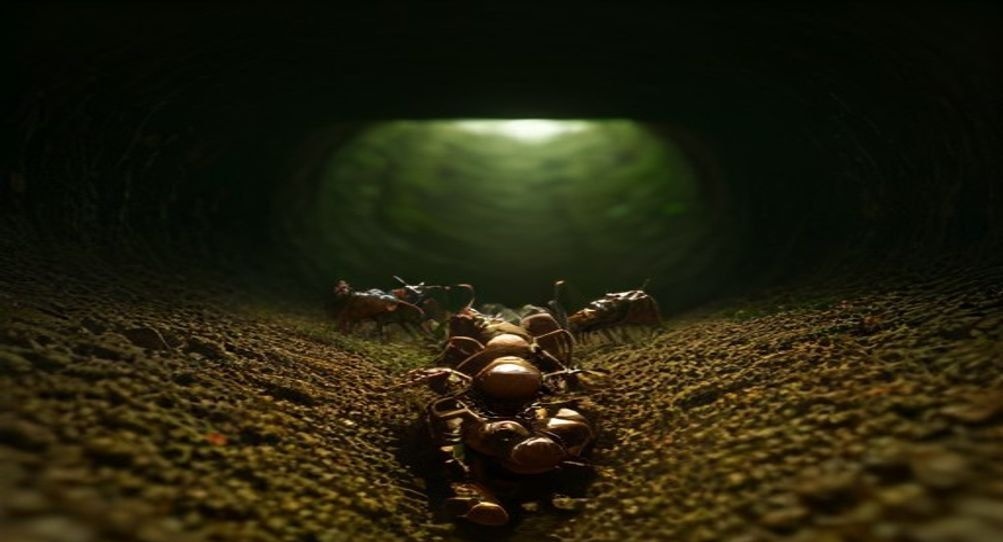
In the study of evolutionary biology, few phenomena are more profound than eusociality—the evolutionary transition from solitary individualism to cooperative colonial living. Coined by entomologist E.O. Wilson, the concept of the “superorganism” views an ant colony, termite mound, or honeybee hive not merely as a collection of individual animals, but as a single, coherent biological organism in its own right. In a superorganism, sterile worker castes function as the somatic cells and internal organs (digesting food, gathering energy, and building defenses), while the queen and kings serve as the germline gonads dedicated purely to reproduction. Examining the genetic architecture, nutritional caste determination, and architectural climate-control engineering of eusocial colonies reveals nature’s most formidable collaborative achievements.
Executive Eusociality Summary
- The Three Eusocial Criteria: True eusociality requires three strict conditions: cooperative brood care, overlapping generations of adults, and reproductive division of labor into sterile and fertile castes.
- Evolutionary Kin Selection: Hymenoptera utilize haplodiploidy (males haploid, females diploid), creating a genetic relatedness of r = 0.75 between sisters, which is higher than mother-daughter relatedness (r = 0.5), mathematically favoring sterile worker cooperation.
- Epigenetic Caste Determination: Whether an ant or bee larva becomes a sterile worker or a massive queen is dictated not by different genetics, but by differential nutrition (e.g., royal jelly) and hormonal titers during critical developmental instars.
- Termite Passive Ventilation: Massive subterranean termite mounds utilize solar chimney thermodynamics and porous outer walls to passively circulate oxygen and expel carbon dioxide without mechanical fans.
Table of Contents
- 1. What is a Superorganism? E.O. Wilson’s Paradigm
- 2. The Genetics of Altruism: Haplodiploidy and Hamilton’s Rule
- 3. Caste Polymorphism: How Nutrition Dictates Morphology
- 4. Termite Societies: Diploid Kings and Fungus Farming
- 5. Architectural Bioengineering: Passive Climate-Controlled Mounds
- 6. Ant vs. Termite Social Systems Comparison Matrix
- 7. Frequently Asked Questions (FAQ)
- 8. The Ecological Supremacy of Social Insects
1. What is a Superorganism? E.O. Wilson’s Paradigm
To understand an ant hill or termite mound, one must shift perspective from the individual insect to the collective colony. A single ant stranded alone in a petri dish cannot survive, cannot reproduce, and cannot build; it is biologically analogous to an isolated red blood cell or liver hepatocyte. The true biological individual is the colony as a whole.
In his landmark treatise The Superorganism, evolutionary biologist E.O. Wilson and Bert Hölldobler demonstrated that social insect societies possess emergent physiological properties completely absent in solitary species. The superorganism possesses a collective digestive system (workers forage, pre-digest food, and share nutrients via mouth-to-mouth liquid trophallaxis), a collective immune system (workers groom one another, apply antibiotic metapleural gland secretions, and quarantine infected nestmates), and a collective circulatory system (ventilated tunnels and convective airflow networks). By acting as a unified unit, eusocial insects account for over fifty percent of all animal biomass in tropical rainforests, despite comprising only two percent of all insect species.
2. The Genetics of Altruism: Haplodiploidy and Hamilton’s Rule
For decades after Charles Darwin published On the Origin of Species, sterile insect castes posed a baffling evolutionary dilemma. Darwin himself noted that sterile worker ants—which sacrifice their own reproduction to raise their mother’s offspring—seemed to directly contradict the core principle of natural selection, potentially threatening to prove his entire theory fatally flawed.
The mathematical breakthrough arrived in 1964 with evolutionary theorist W.D. Hamilton and his famous formulation of kin selection, expressed in Hamilton’s Rule:
r × B > C
Where C is the reproductive cost to the altruist, B is the reproductive benefit gained by the recipient, and r is the coefficient of genetic relatedness between them.
In order Hymenoptera (ants, bees, and wasps), sex determination is haplodiploid. Males develop from unfertilized eggs and are haploid (possessing only one set of maternal chromosomes), while females develop from fertilized eggs and are diploid. Because all sperm produced by a haploid male are genetically 100% identical, full sisters inherit 100% of their father’s genes and an average of 50% of their mother’s genes. Consequently, sisters share an astonishing 75 percent of their genes (r = 0.75) with each other—which is higher than the 50 percent relatedness (r = 0.5) they would share with their own prospective offspring! Hamilton demonstrated that from a strictly genetic standpoint, a female worker ant propagates more of her own genetic blueprint into future generations by staying home and helping her mother queen produce more sisters than by leaving to raise her own daughters.
3. Caste Polymorphism: How Nutrition Dictates Morphology
Inside a mature colony of North American carpenter ants (Camponotus) or big-headed ants (Pheidole), one observes astonishing physical diversity: tiny minor workers tending nursery brood, medium media workers foraging on forest trails, and colossal major “soldier” workers sporting massive, muscle-bound head capsules designed to crush enemy invaders or crack tough seeds. Yet, every single one of these female workers possesses identical DNA.
How does identical genetic code produce radically divergent physical bodies? The answer is epigenetic developmental programming driven by larval nutrition. When larvae are fed low-protein diets, their corpora allata glands secrete low titers of Juvenile Hormone (JH); the larva molts into a minor worker. When nurse ants feed a larva high-protein glandular jellies, JH levels spike above critical developmental thresholds, turning on dormant gene expression suites that stimulate hyper-growth of the head capsule and mandibles, producing a major soldier. In honeybees, feeding larvae exclusive diets of royal jelly (rich in the protein royalactin and 10-HDA fatty acids) triggers epigenetic DNA methylation alterations that unlock full ovarian fertility, transforming an ordinary worker larva into a long-lived, egg-laying queen.
4. Termite Societies: Diploid Kings and Fungus Farming
While ants evolved from solitary wasps within the holometabolous order Hymenoptera, termites (infraorder Isoptera) are completely unrelated evolutionary cousins. Termites are social, hemimetabolous wood-eating cockroaches (order Blattodea) that evolved eusociality over 150 million years ago in the late Jurassic—more than 50 million years before the first ant ever existed.
Termite sociality operates on fundamentally different biological rules:
– Diploid Sex Determination: Both male and female termites are diploid (possessing two chromosome sets). Both sexes work: male and female nymphs serve as sterile workers and soldiers.
– The Permanent King: Unlike male ants and bees, which mate once during a nuptial flight and die immediately, the termite king lives permanently alongside the queen inside the royal chamber, repeatedly fertilizing her over decades.
– Endosymbiotic Digestion: Termites cannot digest raw wood on their own. Primitive termites rely on unique anaerobic protozoan flagellates (and bacterial spirochetes) living in their hindguts to ferment cellulose. In higher termites (subfamily Macrotermitinae), workers construct subterranean fungal combs using masticated wood, cultivating symbiotic Termitomyces mushrooms that pre-digest cellulose outside the body.
5. Architectural Bioengineering: Passive Climate-Controlled Mounds
The monumental mounds constructed by cathedral termites (such as Macrotermes and Nasutitermes) are among the greatest architectural engineering wonders on Earth. Rising up to 15 to 30 feet in height, a single mound can weigh over ten tons and house a superorganism of two million individuals.
The primary engineering challenge of a subterranean colony is respiration and temperature control: millions of living termites and their fungal farms consume massive amounts of oxygen, generating intense heat and suffocating carbon dioxide. The mound solves this through passive thermodynamic ventilation without moving parts:
1. Solar Convection Chimneys: The thick, porous central spire absorbs heat from the blazing sun, warming the air inside the central chimney.
2. Stack Effect Circulation: Warm, stale, CO₂-rich air rises up the central chimney through natural convection and escapes through microscopic porous cuticular pores in the outer walls.
3. Fresh Air Siphon: As warm air exhausts from the top, negative pressure draws cool, fresh, oxygenated air in through low subterranean peripheral tunnels, maintaining internal nest temperatures within 1°C of 86°F (30°C) and relative humidity at precisely 99 percent year-round.
6. Ant vs. Termite Social Systems Comparison Matrix
The comparison matrix below delineates the profound evolutionary, genetic, and developmental contrasts between ant and termite eusociality.
7. Frequently Asked Questions (FAQ)
Does an ant queen give orders to the colony like a military general?
No. The term “queen” is a human anthropomorphism. The ant queen has zero political authority and issues zero commands; she is solely an egg-laying organ and chemical regulator. Colony operations are entirely decentralized, governed by stigmergy and local chemical interactions: individual workers make independent decisions based on local pheromone concentrations, food availability, and physical encounters with nestmates.
How long can an ant queen live compared to a worker?
Ant queens exhibit astonishing longevity. While a sterile worker ant lives for only a few months to a year, queens of species like the black garden ant (Lasius niger) and harvester ants (Pogonomyrmex) routinely live for 25 to 30 years in undisturbed colonies, making them the longest-lived insects on Earth.
Why do winged ants and termites swarm on hot summer days?
Synchronized mass swarming—known as the nuptial flight—is triggered by regional environmental cues, usually occurring on warm, humid afternoons following heavy summer rain. Virgin queens and reproductive winged males (alates) launch into the air simultaneously from hundreds of neighboring colonies, ensuring cross-colony genetic exchange and minimizing inbreeding before the fertilized queens shed their wings to excavate new underground colonies.
8. The Ecological Supremacy of Social Insects
The evolution of the superorganism transformed terrestrial ecology forever. By pooling cognitive, nutritional, and physical labor, eusocial insects overcome the environmental limits that constrain solitary animals. Today, ants aerate more soil than earthworms, termites cycle more carbon in tropical forests than large herbivores, and bees pollinate the vast majority of flowering flora, demonstrating that cooperation is nature’s ultimate evolutionary power.
Key Takeaways for Field Naturalists
- A superorganism acts as a single coherent animal, with workers as somatic cells and the queen as the germline.
- Haplodiploidy makes ant sisters 75% related, providing the mathematical engine for evolutionary altruism.
- Caste differences arise from epigenetic nutritional switches (like royal jelly), not different genetic code.
- Termites are social cockroaches featuring both male and female workers, permanent kings, and thermodynamic mounds.