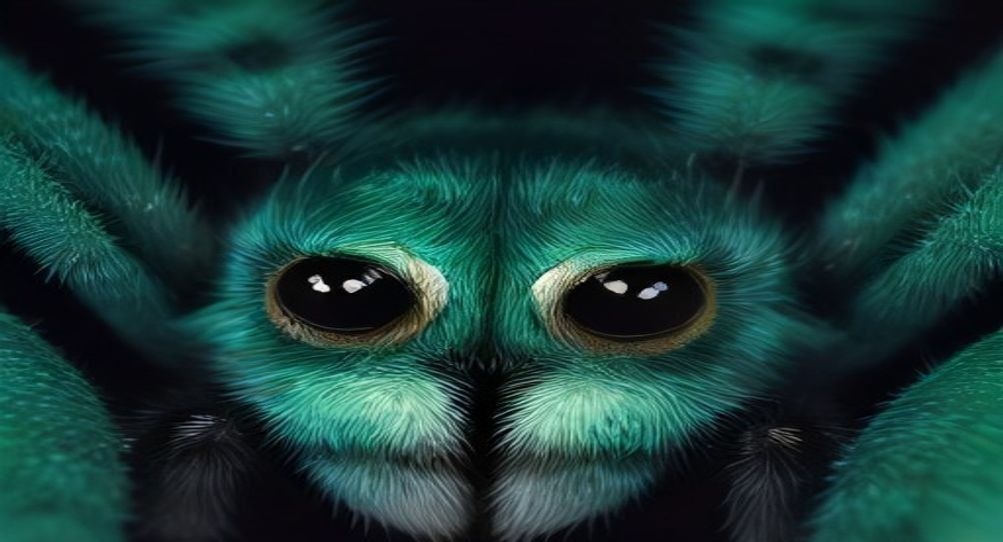
While most spiders are passive web-spinners or nocturnal prowlers relying entirely on tactile silk vibrations, one family has abandoned sedentary webs to become diurnal, visual apex hunters: Salticidae, the jumping spiders. Comprising more than 6,000 described species globally—making it the most diverse family in the entire order Araneae—jumping spiders possess an extraordinary biological toolkit: a high-resolution, multi-tier optical system that rivals primate vision, a hydraulic leg propulsion mechanism capable of launching the spider up to fifty times its body length, and documented cognitive capabilities including spatial detour planning, trial-and-error problem solving, and complex vibratory courtship choreography.
Executive Salticid Summary
- Telephoto Optical Architecture: Salticids possess eight eyes divided into functional roles; the massive Anterior Median (AM) eyes function like telephoto cameras with movable, four-tiered retinas that calculate depth through image defocus.
- Hydraulic Muscle Mechanics: Jumping spiders have no extensor muscles in their knee (patella-tibia) and ankle (metatarsus-tarsus) joints; leaps are powered by instantaneous spikes in cephalothoracic hydraulic hemolymph pressure.
- Silk Lifeline Safety: Before initiating any jump, the spider anchors a strand of major ampullate silk to the substrate, acting as a dynamic bungee brake if the jump misses its target.
- Arachnid Cognitive Flexibility: Genera such as Portia exhibit complex behavioral flexibility, navigating out-of-sight detours to stalk dangerous web-building spiders and mimicking courtship vibrations to lure victims.
Table of Contents
- 1. Evolutionary Dominance of Family Salticidae
- 2. The Four-Tier Optical System: How Spiders See in 3D
- 3. Hydraulic Biomechanics: The Science of the 50x Body Leap
- 4. The Lifeline Anchor: Silk Ballistics and Aerial Deceleration
- 5. Cognitive Problem Solving: The Strategic Detours of Genus Portia
- 6. Jumping Spider vs. Web-Weaver Biological Matrix
- 7. Frequently Asked Questions (FAQ)
- 8. Field Observation Tips & Takeaways
1. Evolutionary Dominance of Family Salticidae
Family Salticidae represents an evolutionary triumph among terrestrial arthropods. While most spider families remain tethered to specialized web designs, jumping spiders broke free from silk entrapment during the early Paleogene period roughly 60 million years ago, co-evolving alongside the explosive diversification of flowering plants and diurnal insects. Today, salticids occupy virtually every terrestrial biome on Earth, from the sub-zero summit of Mount Everest (where Euophrys omnisuperstes lives at 22,000 feet) to the sun-baked sand dunes of the Mojave Desert and human residential gardens.
Their ecological success is anchored in an active stalking strategy. Rather than waiting passively for an insect to blunderingly strike a silk thread, a jumping spider actively patrols foliage, detects a fly up to twelve inches away, stalks it with cat-like stealth, calibrates distance with sub-millimeter precision, and pounces with explosive hydraulic force. This predatory independence necessitated profound evolutionary upgrades in neurological processing power, sensory integration, and muscular efficiency.
2. The Four-Tier Optical System: How Spiders See in 3D
The defining visual feature of a jumping spider is its eight eyes arranged in three rows across the front and sides of its high, square cephalothorax. This optical array operates as an integrated, multi-camera surveillance system with specialized division of labor:
The Telephoto Anterior Median (AM) Principal Eyes
The two colossal central eyes are among the most sophisticated optical organs in the animal kingdom. Unlike human eyes that focus by physically changing the curvature of an internal lens, a jumping spider’s anterior median eye functions like a miniature telephoto Galilean telescope. A large, high-power static corneal lens focuses light down a long, tubular cuticular eye tube onto a four-tiered retina located deep inside the cephalothorax.
Crucially, the eye tubes are connected to six minute oculomotor muscles that move the retinas independently in horizontal, vertical, and rotational axes. The spider can scan its surroundings, track moving prey, and inspect fine textures without moving its head! Furthermore, depth perception in the principal eyes is achieved through a revolutionary physical mechanism: true depth from image defocus. The four retinal layers contain green-sensitive photopigments at different focal depths. Because light of different wavelengths focuses at different distances, the spider compares the crispness of the in-focus image on layer 1 with the blurred, out-of-focus image on layer 2, calculating target distance instantaneously without needing stereoscopic parallax.
The Secondary Lateral Eyes (AL, PM, PL)
The remaining six eyes—Anterior Laterals (AL), Posterior Medians (PM, often tiny or vestigial), and Posterior Laterals (PL)—serve as wide-angle peripheral motion detectors. With a combined visual field spanning nearly 360 degrees, any microscopic twitch or movement in the spider’s peripheral hemisphere instantly triggers a motor reflex, causing the spider to swivel its body around to aim its high-resolution telephoto principal eyes directly at the target.
3. Hydraulic Biomechanics: The Science of the 50x Body Leap
When a jumping spider pounces, it launches itself through the air across distances exceeding 30 to 50 times its body length in approximately 15 to 25 milliseconds. Yet, remarkably, dissection of a spider’s hind legs reveals an anatomical paradox: spiders possess zero extensor muscles in their two primary leg joints (the femur-patella and tibia-metatarsus joints). How can an animal execute superhuman vertical jumps without leg extension muscles?
The answer is hydraulic propulsion. While flexion (curling the legs inward) is driven by conventional muscular contractions, leg extension is powered by high-pressure hemolymph (blood) hydraulics. Running longitudinally through the cephalothorax are massive oblique lateral muscle bands. To jump, the spider contracts these thoracic muscles violently, compressing the prosomal chamber like a squeezed hydraulic syringe. This forces hemolymph at extreme pressure (spiking up to 40 to 50 kilopascals) down the arterial channels of the fourth hind legs. The fluid surge instantly blows the hinged leg joints straight, propelling the spider into the air with explosive acceleration reaching up to 30G (thirty times the acceleration of gravity).
4. The Lifeline Anchor: Silk Ballistics and Aerial Deceleration
Launching into three-dimensional space at high speed carries immense risks: misjudging a jump from a high leaf could mean plummeting to the forest floor or into the jaws of a predator. To mitigate this hazard, jumping spiders have evolved an infallible biological safety system: the silk dragline anchor.
Fraction of a second before hydraulic launch, the spider taps its posterior spinnerets against the substrate, depositing an attachment disc made of piriform silk. As the spider rockets through the air, it draws a continuous thread of major ampullate dragline silk behind it. If the target fly swerves or the spider overshoots a branch, the trailing dragline acts as a dynamic brake. By applying tension to the thread with its hind legs, the spider can arrest its fall mid-air, swing like a pendulum beneath the branch, and climb back up to its starting position within seconds.
5. Cognitive Problem Solving: The Strategic Detours of Genus Portia
Perhaps the most extraordinary dimension of Salticidae is their documented cognitive capacity. Laboratory experiments with araneophagic jumping spiders of the genus Portia have astonished cognitive psychologists. In controlled maze trials where food is visible from an elevated perch but can only be reached by walking completely away from the prey through a complex pathway of branches, Portia pauses for minutes, surveying the landscape. The spider plans a spatial route, turns its back on the food, and follows the circuitous detour through out-of-sight branches to emerge directly above the target prey.
This demonstrates working spatial representation: the spider maintains a mental map of its objective and environment even when the visual stimulus is no longer visible. Furthermore, when hunting dangerous web-building spiders, Portia plucks the silk threads of the host web with its pedipalps and legs, experimenting with trial-and-error vibrational rhythms. It will mimic the struggle of a trapped midge to draw the resident spider out, or mimic the gentle vibratory taps of a courting male to lull the dangerous host into a false sense of security before executing a fatal ambush.
6. Jumping Spider vs. Web-Weaver Biological Matrix
The comparison matrix below highlights the ecological, physiological, and anatomical differences between jumping spiders and classic web-weaving spiders.
7. Frequently Asked Questions (FAQ)
Are jumping spiders friendly or curious toward humans?
Because jumping spiders possess exceptional visual acuity, they can actively perceive human faces and fingers. When a human approaches, a jumping spider will often cock its head, swivel its body, and track human motion with its large central eyes. This behavior, while perceived by humans as “curiosity” or “friendliness,” is an acute optical assessment to determine whether the moving object is a predator, prey, or an impassable obstacle.
Can a jumping spider bite a human?
Jumping spiders are non-aggressive and will invariably choose to leap away or hide when threatened. In the extraordinarily rare event that a large jumping spider (such as the bold jumper, Phidippus audax) is trapped inside clothing and squeezed against skin, its bite causes only mild, localized stinging comparable to a weak mosquito bite, with zero systemic or necrotic consequences.
How do jumping spiders see color?
While most spiders are colorblind, many jumping spiders (especially the famous peacock spiders of Australia and North American Habronattus) possess true trichromatic or tetrachromatic color vision. They utilize specialized red cuticular filters overlying green photoreceptors, enabling them to perceive ultraviolet, blue, green, and vibrant red colors, which is essential for evaluating male courtship dances.
8. Field Observation Tips & Takeaways
Observing jumping spiders in North American backyards is one of the most rewarding pursuits in amateur entomology. Look for them on sunlit vertical surfaces—brick exterior walls, wooden fence posts, and broad garden leaves. Watch as they pause, cock their cephalothorax to judge vertical distances, anchor their safety dragline, and execute flawless hydraulic leaps to snatch garden pests directly out of mid-air.
Key Takeaways for Field Naturalists
- Salticids possess telephoto central eyes with moving retinas that calculate depth via image defocus.
- Leaps are powered by hydraulic hemolymph pressure surges rather than muscular leg extension.
- Every leap is secured by an anchored silk dragline that acts as an emergency bungee brake.
- Jumping spiders exhibit cognitive working memory, mapping indirect detour routes to stalk prey out of sight.