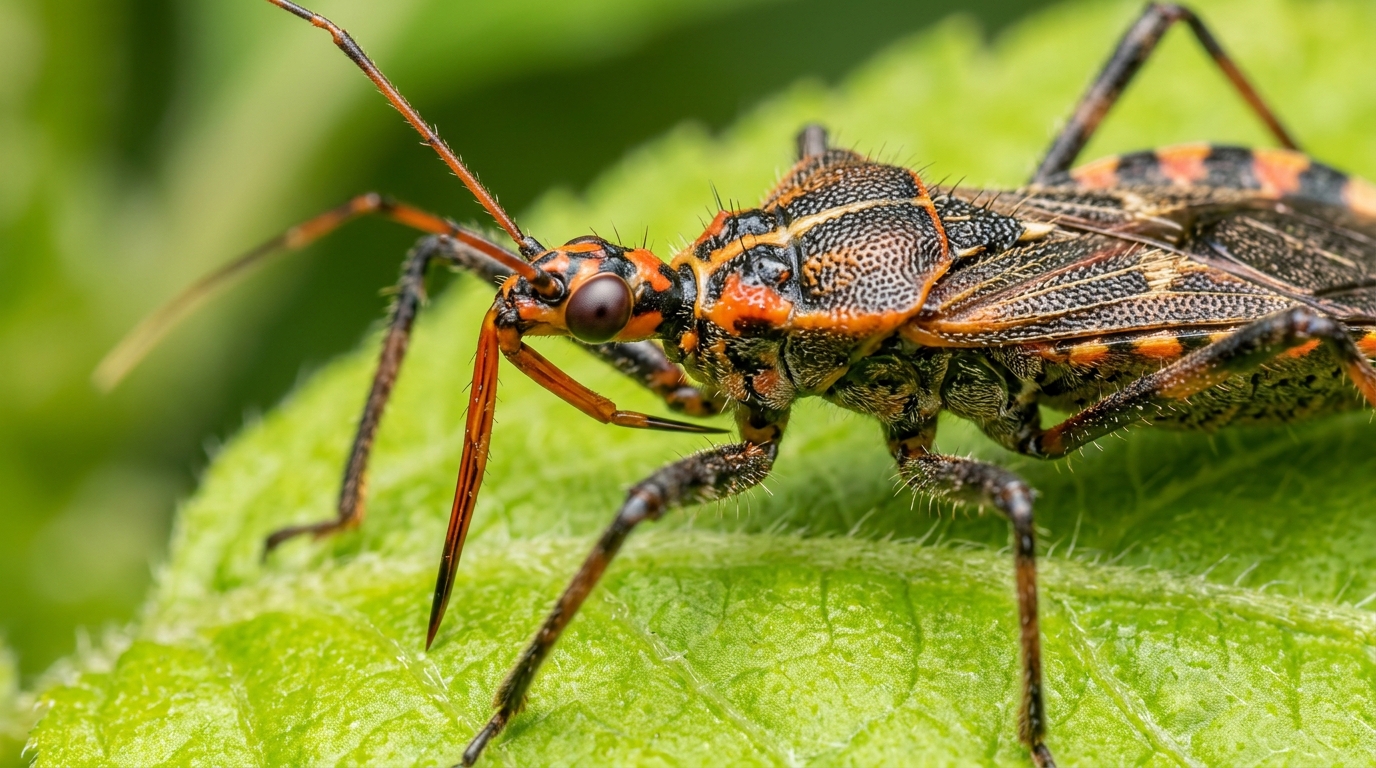
In popular parlance, nearly any crawling, six-legged creature is casually referred to as a “bug.” However, to an entomologist, the term “true bug” has an exact, rigorous taxonomic meaning restricted exclusively to the order Hemiptera. Comprising more than 80,000 described species globally, Hemiptera includes iconic creatures such as cicadas, aphids, leafhoppers, stink bugs, assassin bugs, and water striders. The definitive hallmark of this ancient order is not their overall body shape or flight capability, but the extraordinary mechanics of their mouthparts: a jointed piercing-sucking beak known as the rostrum. Understanding the morphological distinction between true bugs and other insect orders reveals one of the most versatile feeding apparatuses in evolutionary biology.
Executive Entomological Summary
- Rostrum Architecture: True bugs possess a segmented, needle-like beak composed of interlocking mandibular and maxillary stylets housed within an elongated labium sheath.
- Dual Micro-Canal System: The maxillary stylets lock together to form two parallel conduits: a salivary canal for pumping digestive enzymes or anesthetics, and a food canal for sucking liquid nutrients.
- Hemelytra Structure: In typical true bugs (suborder Heteroptera), the forewing is divided into a thickened, leathery basal half and a clear membranous apical tip, folding flat over the abdomen to form an ‘X’ pattern.
- Dual Lifestyles: Hemipterans encompass both destructive agricultural phloem-feeders (aphids, stink bugs) and lethal apex invertebrate predators (assassin bugs, giant water bugs).
Table of Contents
- 1. What Makes a “True Bug”? Entomological Definitions
- 2. Biomechanics of the Rostrum and Piercing Stylets
- 3. Wing Architecture: Hemelytra and the Dorsal ‘X’
- 4. Major Hemipteran Suborders: Heteroptera, Auchenorrhyncha, Sternorrhyncha
- 5. Predatory Assassin Bugs and Aquatic Giant Water Bugs
- 6. True Bugs vs. Beetles & Flies Comparison Matrix
- 7. Frequently Asked Questions (FAQ)
- 8. Field Naturalist Identification Protocol
1. What Makes a “True Bug”? Entomological Definitions
To understand the order Hemiptera, one must clear away common linguistic confusion. In standard English, people refer to beetles, spiders, sowbugs, centipedes, and moths interchangeably as “bugs.” In scientific terminology, however, “bug” is an exact descriptor reserved strictly for the order Hemiptera, and more narrowly for the suborder Heteroptera. Unlike beetles that possess chewing jaws or moths that possess coiled sucking tubes, true bugs possess a rigid, segmented rostrum originating from the anterior or ventral region of the head capsule.
Furthermore, Hemiptera exhibits hemimetabolous (incomplete) metamorphosis. When a young true bug hatches from its egg, it does not emerge as a grub or caterpillar. Instead, it emerges as a miniature, wingless version of the adult, known as a nymph. As the nymph passes through successive instars (typically five molts), its external wing pads gradually enlarge and its reproductive organs mature. At no point in its life history does a true bug enter a dormant, pupal cocoon stage. This distinguishes hemipterans fundamentally from holometabolous beetles, flies, and wasps.
2. Biomechanics of the Rostrum and Piercing Stylets
The evolutionary brilliance of Hemiptera is encapsulated in the rostrum (also referred to as the proboscis or beak). While biting insects use opposable mandibles to masticate solid tissue, the mouthparts of true bugs are modified into four ultra-slender, interlocking chitinous needles termed stylets, encased within a jointed, grooved sheath formed by the labium.
The outer pair of stylets consists of the mandibles, which possess backward-curved serrations or barbed ridges at their tips designed to anchor the beak and saw through tough plant epidermis or animal cuticle. The inner pair consists of the maxillae, which fit together longitudinally via microscopic tongue-and-groove micro-ridges. This tight physical interlocking creates two completely isolated internal conduits:
- The Salivary Canal: Through this canal, powerful salivary pumps inject chemical cocktails directly into the host. In herbivorous aphids and stink bugs, saliva contains pectinases and cellulases that dissolve plant cell walls. In predatory assassin bugs, saliva contains neurotoxins that paralyze prey alongside proteolytic enzymes that liquefy internal organs into a nutrient-rich soup.
- The Food Canal: Once tissues are liquefied, the insect’s cibarial muscle pump—located in the head—contracts cyclically, creating powerful negative hydraulic pressure that pulls the liquefied slurry up through the food canal and directly into the esophagus.
The Resting Position
When not actively feeding, the true bug folds its rostrum backward between its front legs, tucking it flush along the ventral sternum of the thorax. In predatory assassin bugs (Reduviidae), the beak is short, heavily curved, and rests in a specialized grooved prosternal stridulatory furrow; when agitated, the bug rubs the tip of its rostrum against this furrow to produce an audible, raspy warning hiss.
3. Wing Architecture: Hemelytra and the Dorsal ‘X’
The second diagnostic trait of typical true bugs (suborder Heteroptera) is the structure of the forewings, designated as hemelytra (meaning “half-elytra”). In beetles, the forewings are completely hardened from base to tip. In contrast, a hemelytron is divided into two distinct zones: a thickened, leathery, opaque basal section (the corium and clavus) and a delicate, transparent membranous apical section.
When the bug lands and folds its wings flat over its back, the leathery basal portions align horizontally while the membranous tips overlap. This physical overlap creates an unmistakable visual signature: a prominent ‘X’ pattern or diamond shape etched across the insect’s dorsal surface, framed by a triangular scutellum plate situated between the wing bases. This arrangement provides physical protection to the soft abdominal tergites while preserving aerodynamic agility during flight.
4. Major Hemipteran Suborders: Heteroptera, Auchenorrhyncha, Sternorrhyncha
Modern taxonomic consensus divides Hemiptera into three prominent suborders, each occupying distinctive ecological niches across North America.
1. Heteroptera (The Typical True Bugs)
Heteropterans are the only group that possess true hemelytra and a rostrum that arises conspicuously from the front of the head. This group includes shield bugs and stink bugs (Pentatomidae), known for foul-smelling aldehydes released from thoracic scent glands; plant bugs (Miridae), the largest family within the suborder; and seed bugs (Lygaeidae), such as the widespread North American boxelder bug (Boisea trivittata).
2. Auchenorrhyncha (Free-Living Plant-Suckers)
This suborder contains cicadas (Cicadidae), treehoppers (Membracidae), and leafhoppers (Cicadellidae). Unlike Heteroptera, their forewings are uniformly textured (either entirely membranous or uniformly leathery) and roofed tent-like over the body at rest. The rostrum arises from the underside of the head. Cicadas are renowned for having the loudest acoustic signals of any insects, produced by muscularly buckling ribbed chitinous membranes called tymbals.
3. Sternorrhyncha (Plant Parasites and Scale Insects)
Encompassing aphids (Aphididae), whiteflies (Aleyrodidae), and scale insects (Coccoidea), Sternorrhyncha features insects whose rostrum appears to emerge directly between their front legs. Many species are sedentary, wingless, or covered in powdery waxy secretions. Aphids exhibit extraordinary reproductive biology: during spring and summer, females reproduce via unfertilized parthenogenesis, giving live birth to pregnant female clones in rapid succession, resulting in explosive population surges that can overwhelm agricultural crops.
5. Predatory Assassin Bugs and Aquatic Giant Water Bugs
While the majority of hemipterans are vegetarian sap-suckers, several families have evolved into ruthless, formidable predators that dominate both terrestrial foliage and freshwater ponds.
Wheel Bugs and Assassin Bugs (Reduviidae)
The North American wheel bug (Arilus cristatus), reaching up to 1.5 inches in length, is recognizable by the cog-like dorsal crest on its pronotum. As ambush hunters, assassin bugs seize caterpillars, Japanese beetles, and grasshoppers using raptorial front legs before driving their dagger-like beak into the prey’s articular membranes. The injected venom contains powerful neurotoxins and digestive proteinases that kill prey within seconds, transforming the prey’s internal organs into liquid which the wheel bug vacuums out, leaving behind an empty, desiccated exoskeleton.
Giant Water Bugs (Belostomatidae)
Known across North America as “toe-biters” or “electric light bugs,” belostomatids are the apex invertebrate predators of freshwater wetlands, reaching up to 4 inches in length. Equipped with pincer-like raptorial front limbs, they routinely ambush minnows, tadpoles, small frogs, and even juvenile water snakes. After subduing prey, they inject saliva that digests muscle tissue. Interestingly, in many belostomatid genera (such as Abedus and Belostoma), parental care is performed exclusively by the male: the female glues up to 150 fertilized eggs onto the male’s back, and the male carries, cleans, and aerates the brood until the nymphs hatch.
6. True Bugs vs. Beetles & Flies Comparison Matrix
To avoid field misidentification, use the following matrix comparing Hemiptera against beetles (Coleoptera) and flies (Diptera).
7. Frequently Asked Questions (FAQ)
Can true bugs chew solid food?
No, true bugs are morphologically incapable of chewing solid food. Their jaws have evolved exclusively into interlocking piercing stylets that can only ingest liquids. Even predatory species that consume solid prey must first inject digestive enzymes to liquefy the victim’s internal tissues externally before drinking the liquid nutrients.
Are assassin bug bites dangerous to humans in the United States?
Most North American assassin bugs (such as the wheel bug) do not feed on human blood and will only bite if handled carelessly. Their bite is intensely painful—often described as worse than a hornet sting—due to the injection of digestive saliva, but it is not medically dangerous or venomous to humans. However, a specialized subfamily known as kissing bugs (Triatominae) feeds on mammalian blood and can transmit Trypanosoma cruzi, the parasite responsible for Chagas disease, in parts of the southern United States.
Why do stink bugs emit an unpleasant odor when disturbed?
Stink bugs possess specialized metathoracic scent glands that synthesize trans-2-octenal and trans-2-decenal aldehydes. When threatened by a predator, the bug expels these volatile chemical compounds. The pungent aroma repels avian and mammalian predators and also functions as an alarm pheromone warning neighboring bugs to scatter.
8. Field Naturalist Identification Protocol
When identifying an unknown invertebrate in North American fields or gardens, verify these four criteria to determine if it is a true bug:
Diagnostic Checklist for Hemiptera
- Check the underside of the head for a jointed beak (rostrum) that folds backward between the front legs.
- Inspect the wings: look for a triangular scutellum behind the pronotum and an overlapping ‘X’ pattern formed by the hemelytra.
- Observe the juveniles: if the young resemble wingless mini-adults feeding on the same plants, the insect undergoes hemimetabolous development.
- Look for plant-sap feeding or predatory ambushing: true bugs never possess chewing mouthparts or silk-spinning spinnerets.